
MALS
Exhibitor
Postnova Analytics GmbH
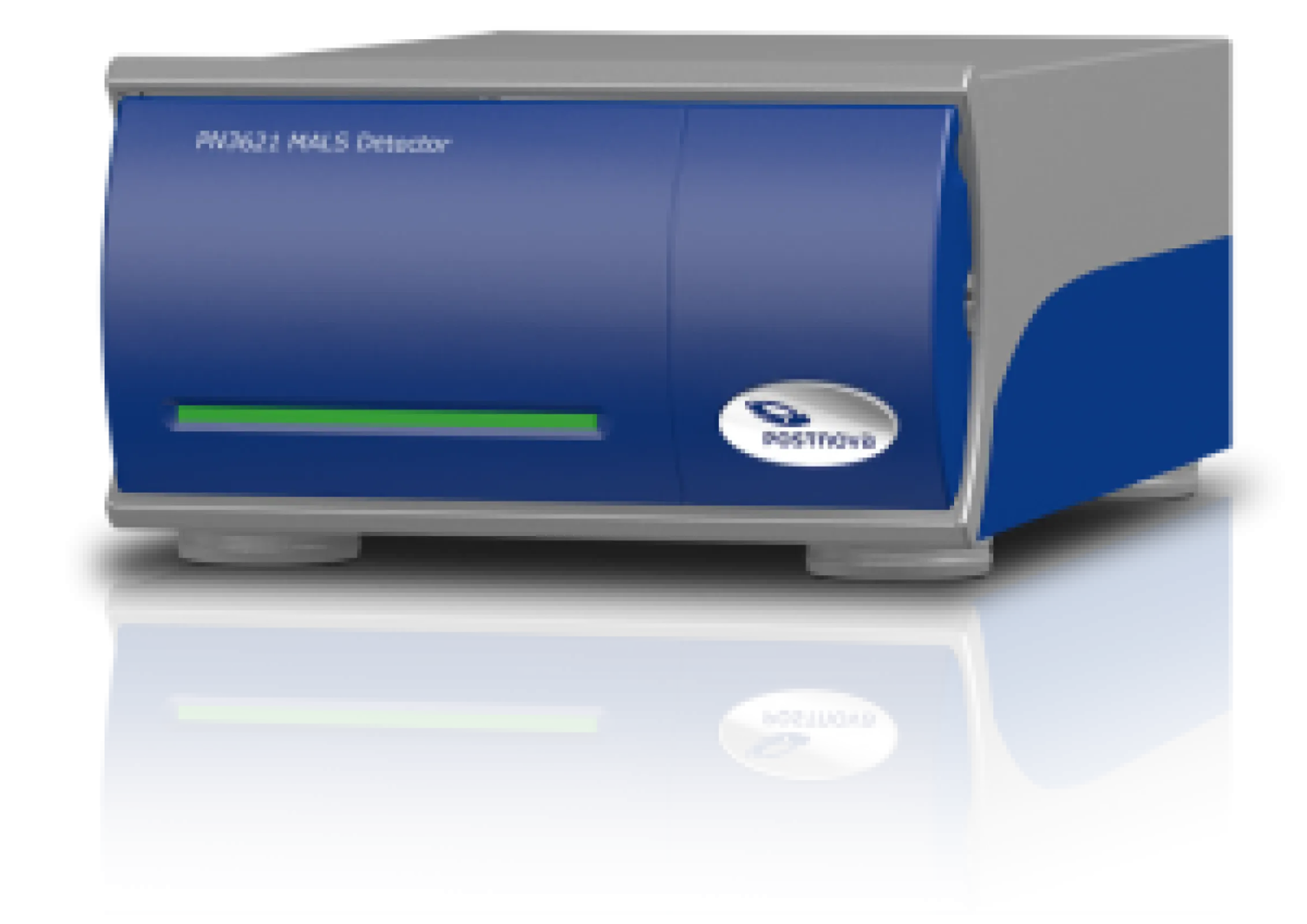
The Postnova PN3600 Series of Multi-Angle Light Scattering detectors was developed specifically for coupling with Postnova Field-Flow Fractionation systems. Based on over two decades of experience in FFF-MALS hyphenation, the PN3621 is the top model of the series, offering the most flexible and powerful MALS solution available, with unique technical features designed for the highest sensitivity, precision, and flexibility.
Maximum number of angles
The PN3621 offers 21 full working angles in aqueous and organic solvents — the broadest angular range of any commercial light scattering instrument available today. This enables the highest precision in molecular weight and particle size determination, particularly for high molar mass polymers, particles, and protein aggregates.
Unique low angle range
Precision depends not only on the total number of angles, but especially on the number of working low angles — critical for branched polymers, high molar mass macromolecules, protein aggregates, and particles. The PN3621 provides a complete set of stable low angles starting at 7°, 12°, 20°, and 28°.
Vertical flow cell
Since MALS is often used to measure larger, fragile sample species, gentle sample treatment is essential to avoid shear forces, chain degradation, conformational changes, or loss of bioactivity. The PN3621's vertical flow cell lets samples pass through without alteration, avoiding the internal obstacles, edges, and dead volumes that can cause aggregation, adsorption, or sedimentation in conventional cells.
Advanced electro-optics
The PN3621 uses the latest opto-electronic and laser designs, with digital signal processing for each of the 21 angles and a true 24-bit resolution AD system for a broad dynamic signal range. Up to 4 external analogue signals can be read in for added flexibility. The instrument is compact, lightweight, and has a small footprint, making it easy to use and transport.
Applications:
Biotechnology – alginates, carrageenans, hyaluronic acids, cell organelles, exosomes
Biopharmaceutical – peptide, protein, antibody, virus aggregates and conjugates
Food and Agro Science – starches, pectins, polysaccharides, proteins, casein micelles
Polymer Science – rubbers, latex dispersions, polyolefins, polyelectrolytes
Environmental Research – humic-fulvic colloids, iron oxides, clays, silica particles
Nanotechnology – TiO2, CNT, C60, latex, ZnO and silica nanoparticles