
Postnova Analytics GmbH
Booth number: SSH3-B22
www.postnova.com
About us
About Postnova Analytics
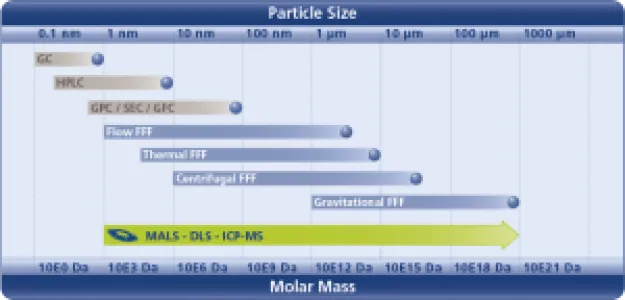
Postnova is the inventor and leader in field-flow fractionation and an innovator in light scattering technology, offering instruments, software, and services used in laboratories of universities, institutions, and corporations worldwide. Its solutions are used to separate and to subsequently characterize nanoparticles and microparticles as well as macromolecules by multiple physico-chemical properties in a single fractionation run.
Fields of application are growing constantly, including life science, as well as material science, and environmental science.
Postnova's portfolio and expertise help its customers to develop and optimize products and production processes, to ensure product quality, to contribute to a safer and more sustainable environment, as well as to fight and cure diseases.
Information about Postnova is available on www.postnova.com.



Address
Rankinestrasse 1
86899 Landsberg am Lech
Germany
E-mail: marketing@postnova.com
Phone: +49 8191 9856880
Internet: www.postnova.com
230 South, 500 East, Suite 110
84102 Salt Lake City, UT
United States
E-mail: info.usa@postnova.com
Phone: +1 80 15212004
Internet: www.postnova.com
Unit 64, Malvern Hills Science Park
WR14 3SZ Malvern, Worcestershire
United Kingdom
E-mail: info.uk@postnova.com
Phone: +44 168 4585167
Internet: www.postnova.com
Contact person:
Dr. Christian Hirsch
Head of Sales
E-mail: christian.hirsch@novenio.com
Products & Services
Postnova Analytics is a leading provider of Field-Flow Fractionation (FFF) systems and detectors for the separation, characterization, and analysis of nanoparticles and macromolecules. Our technology serves a broad range of industries:
Pharma & Biotechnology: e.g. liposomes, exosomes, proteins, viruses, DNA
Nanotechnology: e.g. organic, inorganic, and metallic nanoparticles
Food, Agro & Cosmetics: e.g. starches, chocolate, beer, micelles, sunscreens
Polymers: e.g. rubbers, polyolefins, polysaccharides
Environmental Science: e.g. natural organic matter, sediments, nano- and microplastics
With decades of expertise in FFF technology, Postnova provides tailored solutions that help researchers and manufacturers gain deeper insight into the properties of their materials.
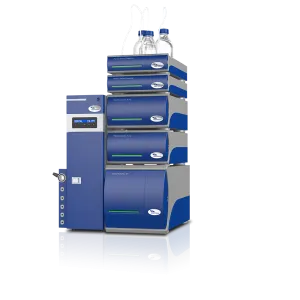
AF2000
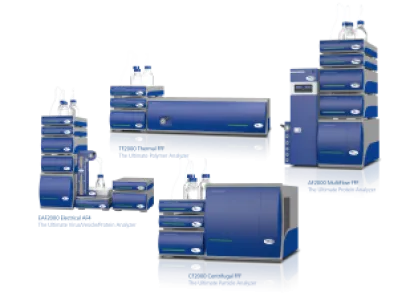
The Postnova AF2000 MultiFlow FFF Series is the first professional modular Flow FFF platform, integrated by the NovaFFF software which runs the entire system from autosampler to detectors. Built on three decades of FFF expertise, it offers superior flexibility, robustness, and performance, setting a new standard in Flow FFF science.
Based on the Flow FFF principle, the AF2000 uses a crossflow field to separate samples by Dynamic Diffusion according to molar mass or particle size. It supports different eluents, various temperature conditions, and multiple channel dimensions — running both planar Asymmetric Flow FFF (AF4) and circular HollowFiber Flow FFF (HF5) channels.
Applications:
Biopharmaceuticals
Food-Agro-Cosmetics
Environmental
Chemicals
Nanotechnology
Ideal for characterizing proteins, antibodies, aggregates, vaccines, liposomes, nanoparticles, and natural or synthetic macromolecules, the AF2000 serves as a universal separator for a broad range of analyte systems.
Two versions available:
AF2000 AT – Non-temperature controlled, economical version for general research use, available in aqueous metal-free, stainless steel, and multisolvent variants
AF2000 MT – Temperature controlled version for advanced research, product development, manufacturing, and quality control; temperature control extends to the entire system, including transfer capillaries
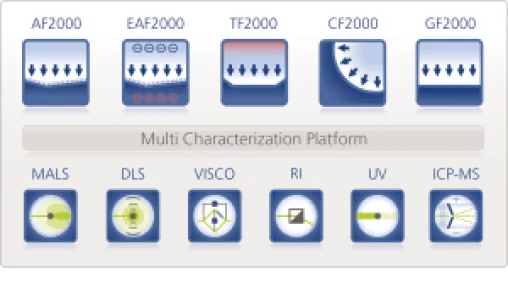
Compatible detectors: UV-Absorbance (UV), Refractive Index (RI), Multi-Angle Light Scattering (MALS), Dynamic Light Scattering (DLS), and Inductively Coupled Plasma Mass Spectroscopy (ICP-MS)
CF2000
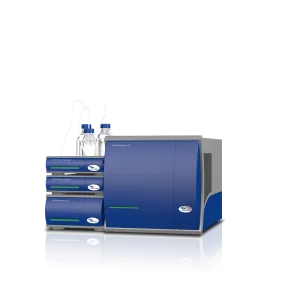
The Postnova CF2000 Centrifugal FFF Series is the first professional modular Centrifugal FFF system, controlled by the NovaFFF software which runs the entire system from autosampler to detectors. Built on three decades of FFF expertise, it offers greater flexibility, robustness, and performance than traditional particle sizer systems, enabling high resolution particle separation and sizing simultaneously.
The CF2000 offers a broad separation range, separating smaller species such as proteins and polymers from larger particles in a single run with high resolution. It is ideal for nanoparticles and also suitable for the microparticle range. Unlike traditional batch-mode particle sizing techniques, Centrifugal FFF physically separates each particle fraction prior to sizing — avoiding low size resolution and the discrimination or underestimation of smaller particles by larger ones. As with Flow FFF, no special sample treatment is required; samples can be injected directly without filtration.
Typical samples:
Latex, silica, TiO2, ZnO, Ag and Au particles
Sediment and organic/inorganic particles from surface, ground, and waste waters
Based on the Centrifugal FFF principle, the system uses a centrifugal field to separate particles by Dynamic Diffusion according to both particle size and density — a unique feature that allows separation of different particle materials with the same size. Separation can be further optimized using different eluents and temperature programs.
Applications:
Environmental
Food-Agro-Cosmetics
Nanomaterials
Compatible detectors: Refractive Index (RI), Multi-Angle Light Scattering (MALS), and Dynamic Light Scattering (DLS)
SEC
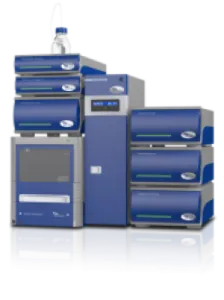
The Postnova SC2000 Modular SEC system is the first truly modular multi-detector SEC/GPC platform, offering unrivalled flexibility for a wide range of applications in the separation and characterization of polymers, proteins, and polysaccharides.
The system incorporates state-of-the-art detection technologies, including light scattering (Multi-Angle Light Scattering, MALS) for absolute molecular weight determination and viscosity detection for structural and conformational data. A broad range of additional detectors and accessories can be combined to build a system uniquely tailored to specific application requirements, with modularity that allows easy future expansion.
The SC2000 can also be expanded to include FFF modules, enabling both SEC and FFF separations to be carried out on the same sample within one instrument platform.
Drawing on over three decades of leadership in separation science, Postnova has designed a solid, stable SEC platform to help users achieve maximum success with their applications.
MALS
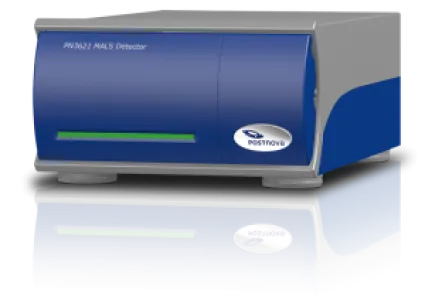
The Postnova PN3600 Series of Multi-Angle Light Scattering detectors was developed specifically for coupling with Postnova Field-Flow Fractionation systems. Based on over two decades of experience in FFF-MALS hyphenation, the PN3621 is the top model of the series, offering the most flexible and powerful MALS solution available, with unique technical features designed for the highest sensitivity, precision, and flexibility.
Maximum number of angles
The PN3621 offers 21 full working angles in aqueous and organic solvents — the broadest angular range of any commercial light scattering instrument available today. This enables the highest precision in molecular weight and particle size determination, particularly for high molar mass polymers, particles, and protein aggregates.
Unique low angle range
Precision depends not only on the total number of angles, but especially on the number of working low angles — critical for branched polymers, high molar mass macromolecules, protein aggregates, and particles. The PN3621 provides a complete set of stable low angles starting at 7°, 12°, 20°, and 28°.
Vertical flow cell
Since MALS is often used to measure larger, fragile sample species, gentle sample treatment is essential to avoid shear forces, chain degradation, conformational changes, or loss of bioactivity. The PN3621's vertical flow cell lets samples pass through without alteration, avoiding the internal obstacles, edges, and dead volumes that can cause aggregation, adsorption, or sedimentation in conventional cells.
Advanced electro-optics
The PN3621 uses the latest opto-electronic and laser designs, with digital signal processing for each of the 21 angles and a true 24-bit resolution AD system for a broad dynamic signal range. Up to 4 external analogue signals can be read in for added flexibility. The instrument is compact, lightweight, and has a small footprint, making it easy to use and transport.
Applications:
Biotechnology – alginates, carrageenans, hyaluronic acids, cell organelles, exosomes
Biopharmaceutical – peptide, protein, antibody, virus aggregates and conjugates
Food and Agro Science – starches, pectins, polysaccharides, proteins, casein micelles
Polymer Science – rubbers, latex dispersions, polyolefins, polyelectrolytes
Environmental Research – humic-fulvic colloids, iron oxides, clays, silica particles
Nanotechnology – TiO2, CNT, C60, latex, ZnO and silica nanoparticles
VISCO
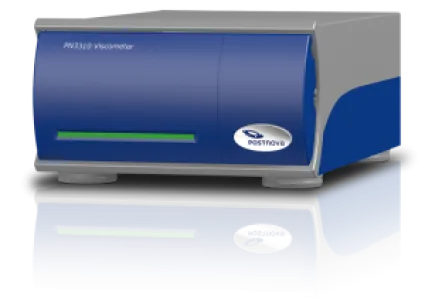
The Postnova PN3310 Viscometer is a state-of-the-art intrinsic viscosity detector for Field-Flow Fractionation (FFF) and Size Exclusion Chromatography (GPC/SEC). Based on the proven Wheatstone-Bridge design, it measures the intrinsic viscosity of macromolecules in solution and features the modern, compact Postnova FFF detector design.
The PN3310 delivers outstanding performance with highly sensitive pressure transducers. Its Pressure Sensor Protection (PSP) system automatically prevents critical overpressure on the transducers, while the instrument offers excellent baseline stability with extremely low drift and a superior signal-to-noise ratio. Up to four analog signals from external detectors (e.g. RI, UV, Fluorescence) can be connected. The detector is fully controlled by the NovaMALS software, which can also integrate additional detectors such as Multi-Angle Light Scattering (MALS), Refractive Index (RI), and UV Absorbance.
Modular detection systems
Combined with the Postnova PN3621 MALS detector and PN3150 RI detector, a modular, flexible, and compact Triple Detection System can be configured. Adding a PN3211 Dual Wavelength UV or PN3242 Diode Array UV as a second concentration detector allows a Quadruple Detection System to be set up.
Molecular size and structure
Using the PN3310 together with a concentration detector (RI, UV) and a light scattering detector (MALS), both the molecular size (hydrodynamic, gyration) and structure (shape, branching) of macromolecules can be determined. With or without an added light scattering detector, the Mark-Houwink plot (molecular weight vs. intrinsic viscosity) can be derived using the NovaMALS software — one of the most powerful structure plots in macromolecular analysis, providing extensive information on the size, shape, structure, and molecular weight of macromolecules in solution.